

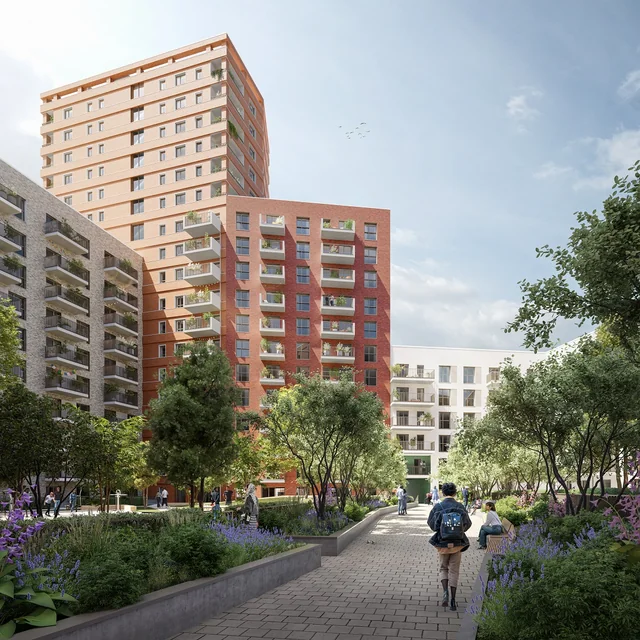
Coventry Society has set up a sub-committee that considers planning applications submitted to the City Council. Last year, we looked in detail at 77 applications and made responses to 26 of these. One of our emerging concerns has been the disappointing and uninspiring quality of the design-related aspects of some of the proposed developments. By this we mean not just the physical appearance of the buildings and the layout but also the infrastructure (such as school and health provision) and quality of the open space.
For example, a current residential development application at the Daimler site on Sandy Lane has, in our opinion, five design-related failings:
- Density and number of homes: An outline application was originally granted for up to 250 units but the proposed scheme is for only 132 dwellings, even though government guidance emphasises densification of urban sites.
- Urban design and layout: The local terraced housing context is referenced in the layout, but there is a failure to take account of the adjacent medium rise apartment blocks (eg Electric Wharf) – a mix of styles is required.
- Heritage: Whilst there is a proposal for a car-themed children’s play area, we are disappointed that there is no attempt to highlight the importance of the site in Coventry’s motor car history
- Coventry Canal Conservation Area: The design of the scheme must contribute to promoting the importance of this conservation area. Also there is no reference to the conservation area management plan.
- Existing users: The site includes the Daimler Powerhouse which is home to a nationally and internationally important arts and culture organisation, but there appears to have been little thought by the developer on how to integrate functionally this use with the residential layout.
It is, therefore, timely that the Council is running a consultation until 10 March on “designing Coventry” which will form the basis for a design code – see Designing Coventry | Let’s Talk Coventry. This is a statutory requirement and Council will use it in helping to influence and improve green spaces, community facilities, housing types, and architectural features for new schemes. Interestingly, the government is also consulting on design and placemaking primarily for new developments – see Design and Placemaking Planning Practice Guidance: consultation document – GOV.UK.
The key question is will these two initiatives contribute to improving the quality of the built and natural environments in Coventry? It’s a useful starting point, but there are three challenges:
- Have and will the Council have sufficiently qualified staff to take forward design-related improvements?
- What about our existing heritage such as our 18 conservation areas and our listed buildings? In fact, 12 of the conservation areas do not even have a current management plan and hardly a week goes by without coverage in the media of their dilapidated and deteriorating state of these potential assets for the city
- Significant new developments form only about 1% of our built environment each year and both consultations focus on these types of schemes. So what is going to be done to improve existing neighbourhoods?
The latter point is illustrated by lack of infrastructure on some recently completed housing estates which is a recurring issue. Bannerbrook Park residents, for instance, continually complain that the proposed school, health facilities and public transport that were promised have never materialised. Yet these are what helps to make a new estate a community worth living in!
You can input into the Council’s design strategy here.